
Goodviser Research
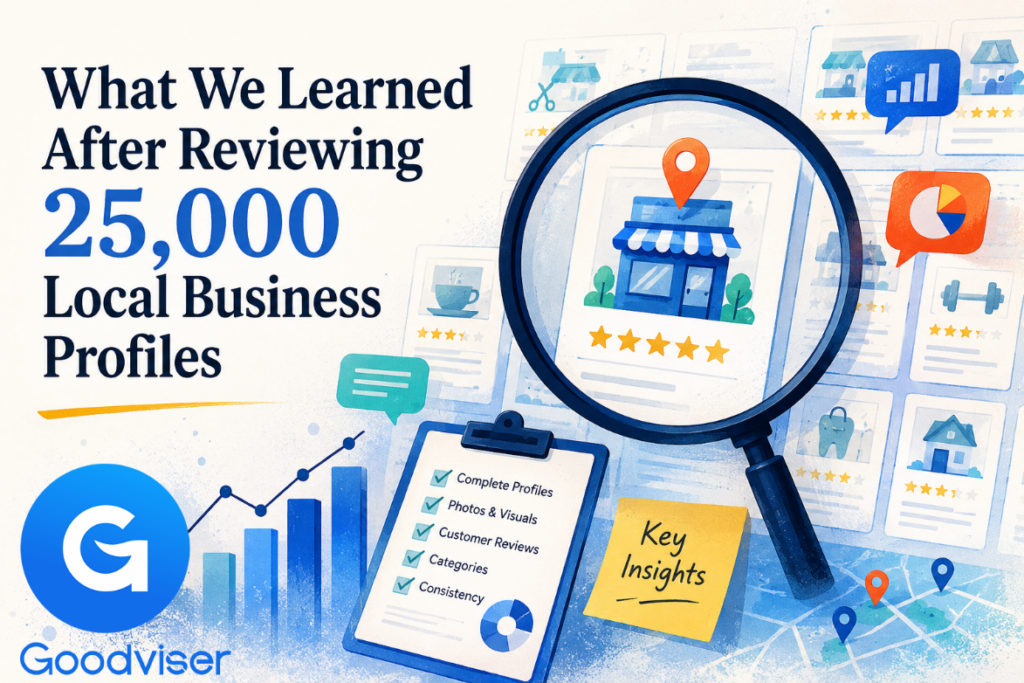
What We Learned After Reviewing 25,000 Local Business Profiles
When people search for a local business today, they expect to find reliable information within seconds.
A working phone number. A website. Business hours. Maybe a few recent reviews.
If any of those pieces are missing, outdated, or inconsistent, the experience quickly becomes frustrating.
While building Goodviser, we reviewed and maintained a database of more than 25,000 local business profiles across a wide range of industries. Although our goal was to build a better platform for discovering local businesses—not to conduct a formal audit—we began noticing the same patterns again and again.
Many business profiles contained outdated or incomplete information that could make it more difficult for customers to contact a business or verify that it was still active.
The issues were surprisingly consistent regardless of industry. One of the most common findings was incomplete contact information. Some businesses listed a phone number but had no website.
Others had a website that no longer worked. In some cases, different directories displayed different phone numbers, addresses, or business hours for the same company.
 For a customer trying to schedule an appointment or request a quote, even small inconsistencies create unnecessary friction.
We also found a large number of business profiles that appeared to have been abandoned.
Their descriptions referred to services no longer offered. Social media links led to inactive accounts.
Business hours had not been updated in years.
Some websites displayed expired security certificates or pages that failed to load entirely.
None of these issues necessarily reflected the quality of the business itself.
Many may have resulted from routine changes—a new phone number, a redesigned website, a move to a new location, or simply the lack of time to maintain listings across multiple platforms.
Still, from a customer’s perspective, the outcome is the same: uncertainty.
That uncertainty matters because modern consumers rarely rely on a single source of information.
A typical customer might discover a business on Google, compare it with another directory, visit its website, and check social media before making contact.
When each source presents different information, confidence naturally decreases.
Maintaining accurate business information has also become more challenging.
A single business may appear across Google Business Profile, Apple Maps, Yelp, Facebook, Bing, industry-specific directories, local chamber websites, and dozens of smaller listing services.
Keeping every profile synchronized requires ongoing attention, especially for businesses that have changed locations, expanded services, or updated contact information.
Another observation involved business descriptions.
Many profiles contained only a company name and a phone number.
They offered little explanation of what the business actually does, what areas it serves, or why a customer should choose it over competitors.
Even a short, well-written description can help customers understand whether a business matches their needs.
Photos showed similar patterns.
Many profiles still displayed images that were years old, low quality, or no longer represented the current business.
For service businesses, recent photos often provide one of the strongest signals that a company is active and engaged.
These observations suggest a simple conclusion.
For many local businesses, improving online visibility is not always about adding more marketing channels or increasing advertising budgets.
Sometimes the greatest opportunity lies in maintaining the information customers already rely on.
A periodic review of phone numbers, websites, business hours, addresses, descriptions, photos, and social media links requires relatively little time, yet it can significantly improve the overall customer experience.
Today, simply creating an online business profile is no longer enough. A company’s online presence has become just as important as its physical location, the quality of its services, or the experience it provides. For many customers, the information they find online forms their very first impression—and often influences whether they choose to contact a business at all.
In today’s competitive market, businesses should treat their online profiles as living assets. Keeping contact information up to date, publishing news and updates, sharing recent photos, responding to customer questions, engaging with reviews, and maintaining an active presence all help build trust and demonstrate that a business is reliable and engaged. An active, well-maintained profile sends a very different message than one that appears abandoned or outdated.
This is also why local business platforms are evolving beyond simple online directories into complete communication and engagement tools. Goodviser was built with that vision in mind. The platform allows small and medium-sized businesses to promote their services for free, publish updates and special offers, communicate directly with potential customers, answer questions, collect customer reviews, and build long-term credibility. Rather than simply listing a business online, Goodviser helps businesses showcase their expertise, stay connected with their audience, and unlock their full potential without requiring a large marketing budget.
As Goodviser continues to grow, we plan to publish additional research based on patterns observed across local business profiles.
Our goal is to help businesses better understand how customers discover them online and identify practical opportunities to improve their digital presence.
Team Goodviser